About 3D modeling and grids
Three-dimensional (3D) grids are used extensively to model processes that occur in asymmetric 3D space, from air flow around objects, to electric fields, to the modeling of fluid flow in underground oil reserves. Different types of grids exist to handle these modeling challenges.
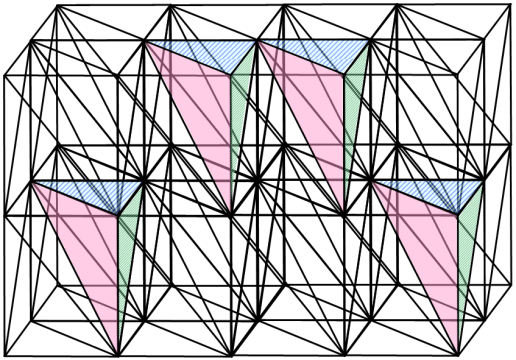
Tetrahedral grid click to enlarge
Tetrahedral grids have a flexible shape that can be adjusted to any space but the random nature of a tetrahedral grid makes it difficult to store large volumes of information. It also complicates solution algorithms, limits the resolution of the 3D grid, and makes it harder to deal with discontinuous spaces, such as faulted layers in the subsurface.
Various types of regular 3D grids have also been developed for modeling subsurface areas. The simplest is the voxel model: A rectangular grid with fixed cell sizes and a fixed number of cells in each of the three directions (I, J, K) which correspond to the X, Y, and Z directions in 3D space. This is a crude way to model the complexity of the subsurface, but the advantage of a voxel grid is that its geometry can be described using a limited number of parameters.
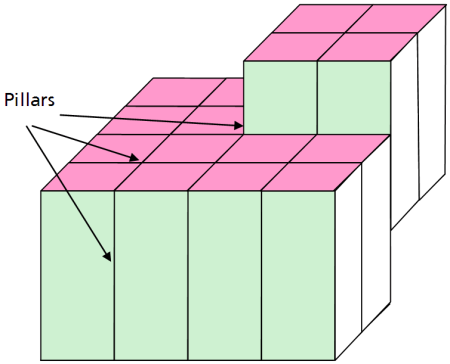
Shifting grid cells along pillars to model subsurface discontinuities (dip-slip) click to enlarge
To improve the modeling of subsurface layers, more flexible 3D grids are desirable. The use of strictly orthogonal I, J, K grid blocks improves the accuracy of fluid flow calculations when using a subsurface model. Modeling subsurface discontinuities by shifting a number of cell stacks along the vertical pillars of the grid helps maintain orthogonality. However, this method only allows the modeling of certain features, such as dip-slip faults.
3D grids run into problems modeling other features, such as strike-slip faults, or areas where two discontinuities truncate against each other. Solutions for this, such as pillar truncations, sometimes create undesirable distortions in the model when trying to represent complex subsurface geometry.
Hybrid grid types have been developed that combine the advantages of the tetrahedral grid (flexible shape) with the advantages of the regular grids (less data storage, easier to handle). For example, a hybrid grid might use tetrahedral cells near faults and regular cells everywhere else. The disadvantage of a hybrid solution is that it minimizes the advantages of the regular grid: It is no longer really regular, and the algorithms have to be adjusted for both cell types.